graffiti

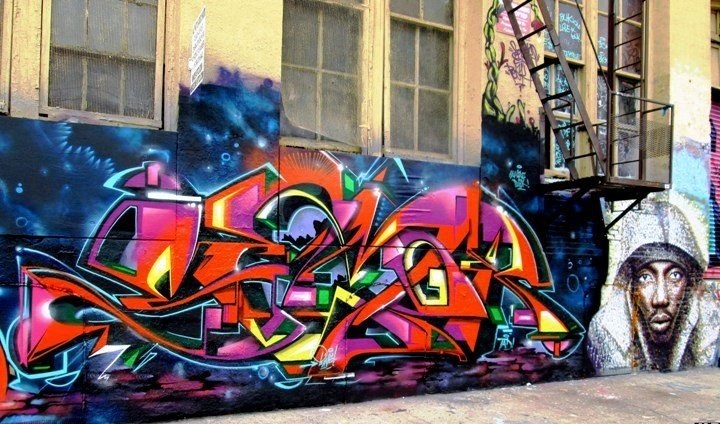
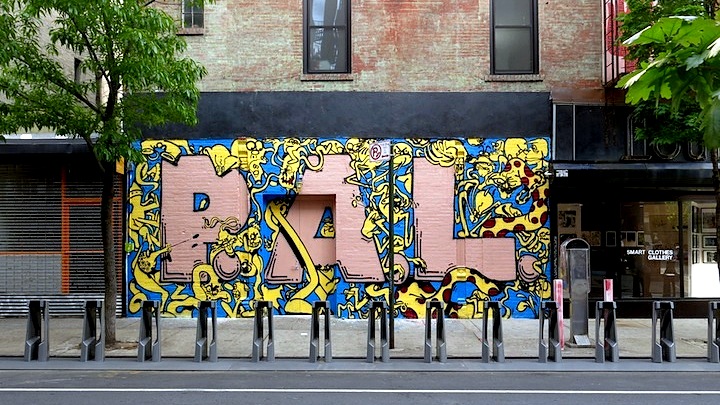
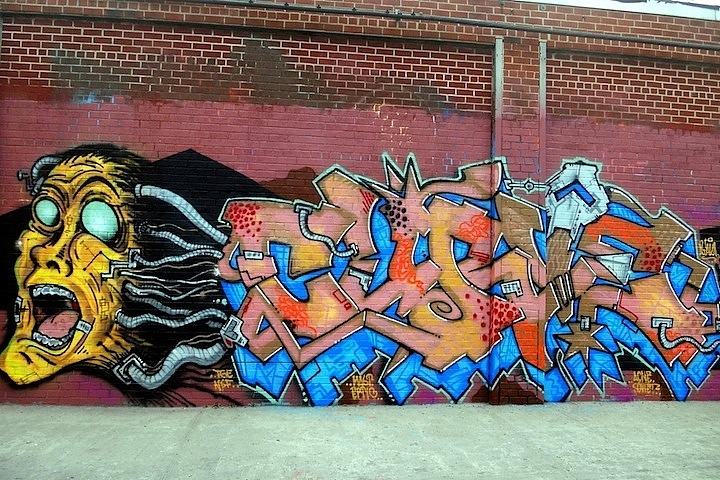
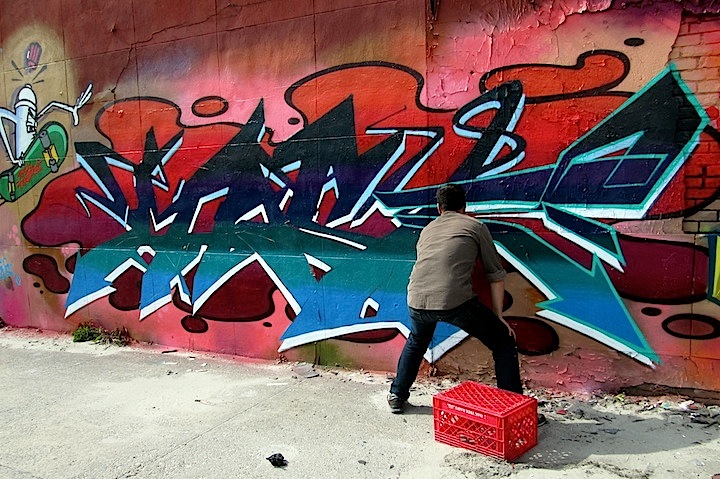
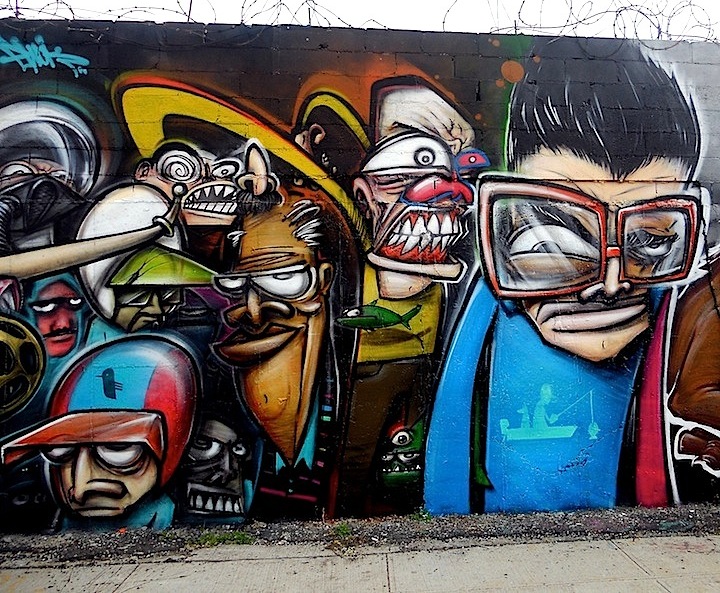
Of the many new pieces to surface at 5Pointz since it began its 11th season last month, a particular stand-out is the huge mural by Phillip Perez aka Article. Curious about the artist behind this singular graffiti aesthetic, we posed some questions to him.
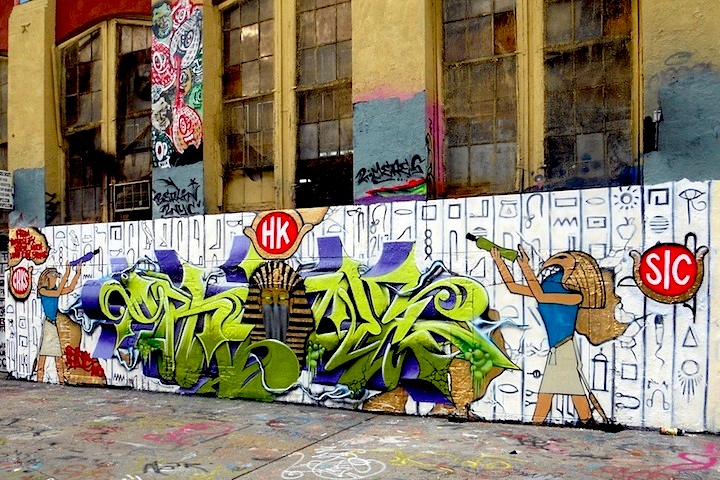
article-mural-at-5Pointz-NYC

When did you start getting up?

I first started in Houston, Texas — back in 1992.

What inspired you at the time?

It started when my friend Big Mark aka KRAM, a B-Boy (Rock Skittles Krew) and a graffiti artist, showed me a video that featured break dancing and graffiti. Before then, I hadn’t seen anything like it. Two days after watching that video, I went bombing. I spray-painted in an alley behind my house.

Any memories that stand out from those early days?

A neighborhood hothead, SKEEZ 181, invited me to paint in a train yard for a graffiti battle. I don’t know how he got my number, but he did. He gave me a call one day and said he’d even pay for the paint and pick me up at my place. I was young and crazy, so I agreed. It was me and Ceroe against all of Hou-Tex freaks in a train yard in Denver Harbor. And as we were painting, a couple of train cops rolled up on Ceroe at the end of the car and start shooting at us. We all hopped about six sets of train tracks while dodging the bullets. Everyone got out of there alive. We even became good friends after. Never did like train yards, but I did it that once!
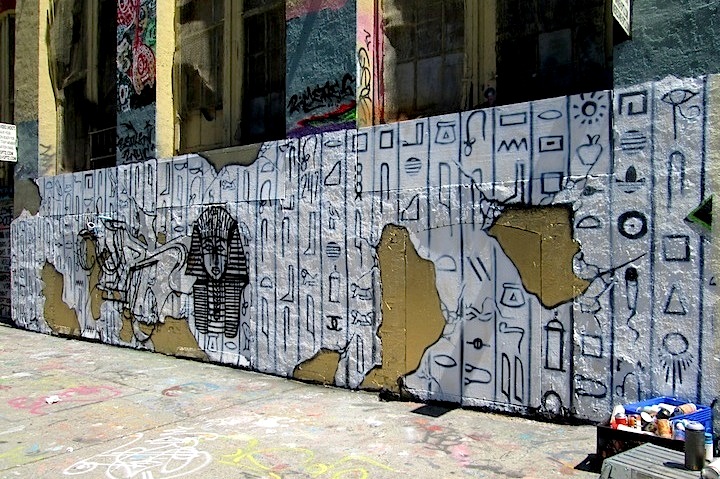
Article

Have you any preferred surfaces?

No favorites. I’m a city bomber; any surface will do. The laws here don’t allow graffiti to live too long. A month maximum and bombs are buffed. So as a writer in Houston, you have to be very selective where you bomb. Location is key!

What’s the riskiest thing you’ve done?

I painted a wall along this railroad track with a couple of friends. Soon, the police rolled by and we were forced to hide in this ditch of muddy water amidst a horrible stench and a swarm of mosquitos. We couldn’t move or sneeze. The cops knew that there had been painting going on, as there was that strong smell of paint in the air. When the police left, we jumped out of there and ran. When we did, a police officer saw us, and hit full speed. To get away, we had to jump over barbed wire gates. We made it, but we separated as we dodged the cops. We met back up again about an hour later.

Have you ever been to jail?

Yes. When I was young, I went to jail for a lot of crazy things, but not for my graffiti art. I’d never go to jail for that. I’d feel too awful getting caught for my art.
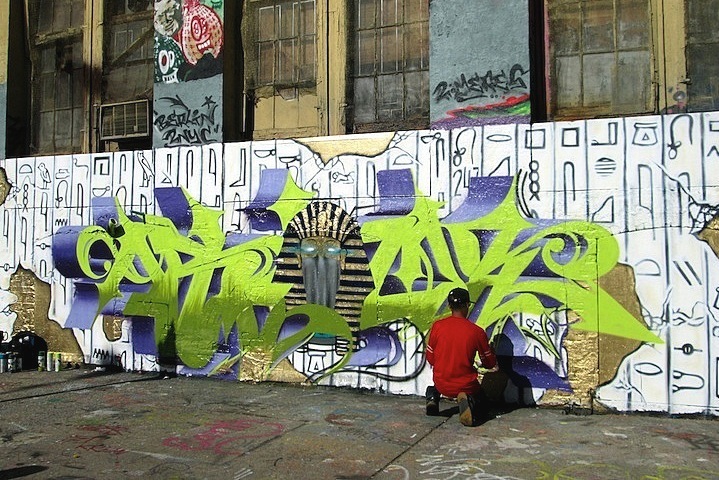
Article

Can you tell us something about some of the other writers down in Houston?

When I started out in the early 90’s, there were hardly any graffiti bombers. There were a few graffiti artists, though.  Nekst and Vizie started here in the mid ’90’s and moved on to work with MSK — from what I understand. I respect those kids. They could have done anything in life, but they chose graffiti as a lifestyle. Episode, Color One, SKEEZ 181, The One Lee, Cease, Dual — are a few cats that live the lifestyle and keep things real in the H.

Who or what inspires you these days?

The lack of real graffiti nowadays is what inspires me to keep at it and teach it — when possible. This new generation needs to learn the foundation and history of this culture before they try to rub elbows with self-made artists. It’s a big let down when I meet a cat who can rock a 3-D but can’t paint regular letters or write with a nice hand style. But there are still sick artists coming out of the woodworks.

Are you down with any crews?

I’m in Hyroglifx Krew 182. We’re like a family here and help each other out. I don’t see it happening these days with many other crews. Internet crews have members who don’t even know each other. We were all born and raised in the North Central Houston.

Have you exhibited your work?

I have in the past few years, and I’m looking to exhibit more regularly.
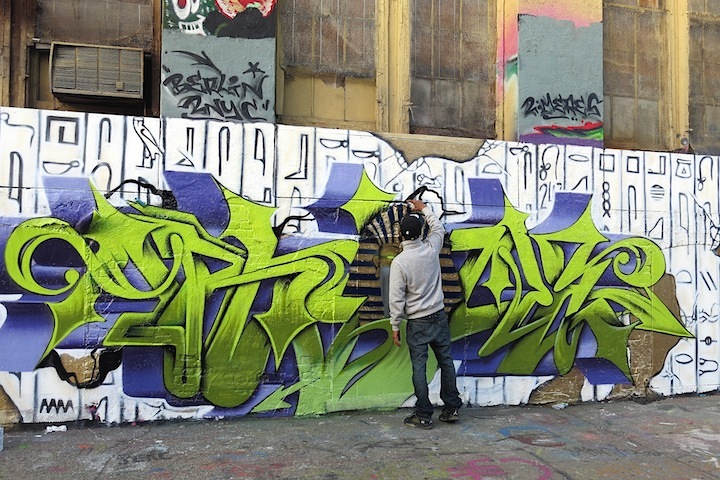
Article

Do you have a formal arts education?

No. My art have been my true education. It has taught me to write proposals and contracts, research history and conduct business. Art has taught me everything. When in school, I felt like the institution was misguiding me.

What’s the attitude of your family and friends towards what you do?

My mom bought me my first can. She has been supportive of the graffiti art, but not of the graffiti bombing. It’s a life style and culture. For me, graffiti is a rare art form. I often find myself explaining it to friends. I never get any real negative feedback from them, though.

What percentage of your time is devoted to writing?

It’s a balance. I have to maintain my commercial works and still fit in my street time. My heaviest bombing years were throughout the 90’s. I’ve had to slow down in the 2000’s because of paid gigs, which took up a lot of time and energy.

,Have you a steady day job?

Yup! I have an in-house art gig for a corporation. It helps me pay the bills and buy paint supplies. When I’m not working there, I do commission work for various people. Along the way, I’ve met a lot of actors, musicians and politicians who are interested in what I do. So luckily, I get to work for them and anyone else who needs art of any kind.
Article

What about other interests?

Anything that is even vaguely art-related interests me. I’m also interested in history.

How has your work evolved throughout the years?

It’s evolved a ton. I taught myself foundation, structure, color schemes and balance. And through that learning process, my work naturally evolved into what it is today.

How did you connect with 5Pointz?

My boy Episode gave me Meres’s number and I texted him. A thousands miles later — with a hundred pounds of paint — I presented my layout to Meres, who approved the sketch and got me straight to work.

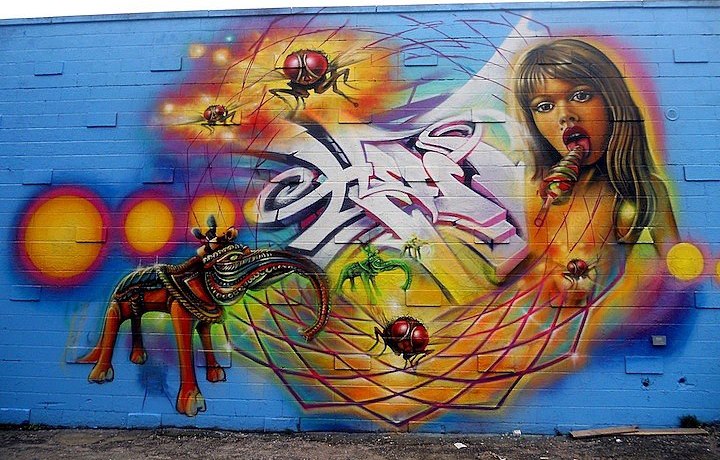
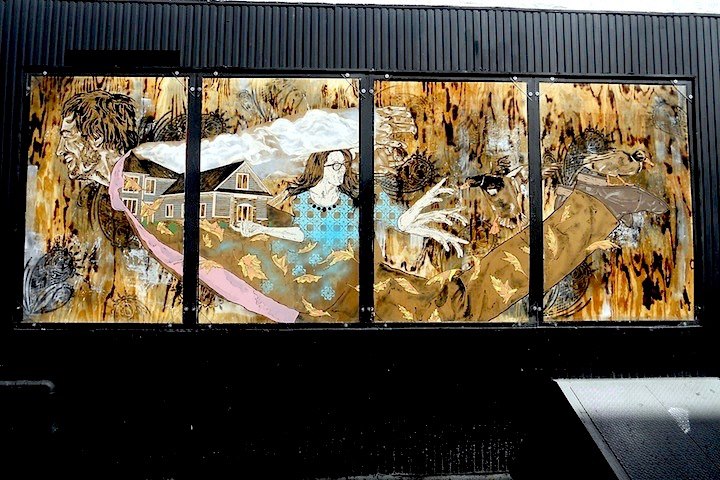
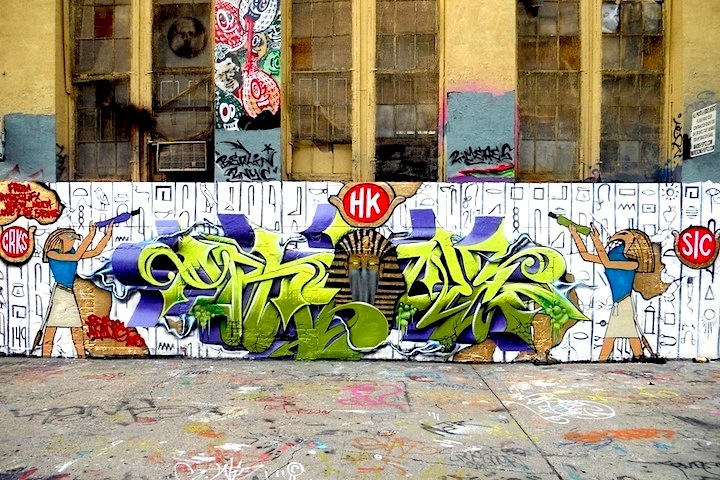
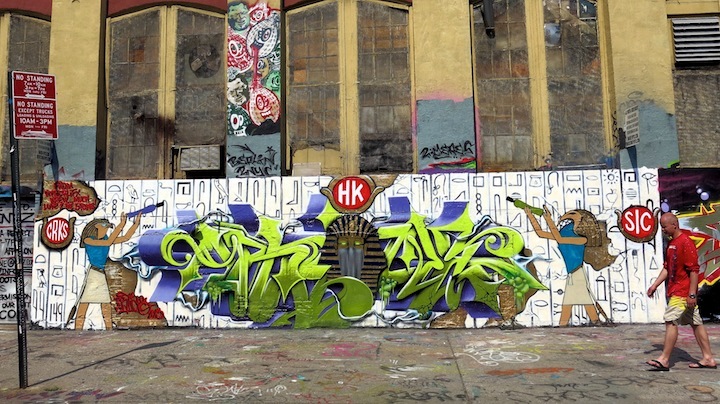
Can you tell us a bit about this image?

It’s a memorial wall — a tribute to the building representing the kings, the OGs of New York City graffiti. I don’t want to see the building torn down. With its gold background, the piece represents the significance of 5Pointz. The hieroglyphics are actually names of important writers such as Stay High 149, Dondi and IZ the Wiz, to name a few. And overall, the work represents the style of my crew. It’s an offering to the 5Pointz community and its importance in the movement. Even in Houston, we know its value.

Interview by Lenny Collado; photos by Lenny Collado, Tara Murray and Lois Stavsky

{ 1 comment }
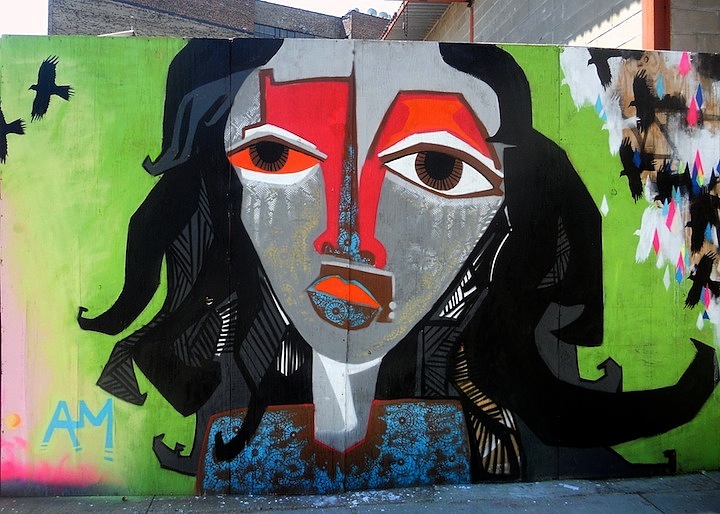
This is the ninth in a series of posts featuring images of girls — and women — who grace New York City’s public spaces:

Alice Mizrachi aka AM in Bushwick, Brooklyn

Alice Mizrachi

Cake in Bushwick, Brooklyn

cake-street-art-in-Bushwick

Hef’s hastily-buffed piece in East New York

Hef

Toofly at the Bushwick Collective

Toofly

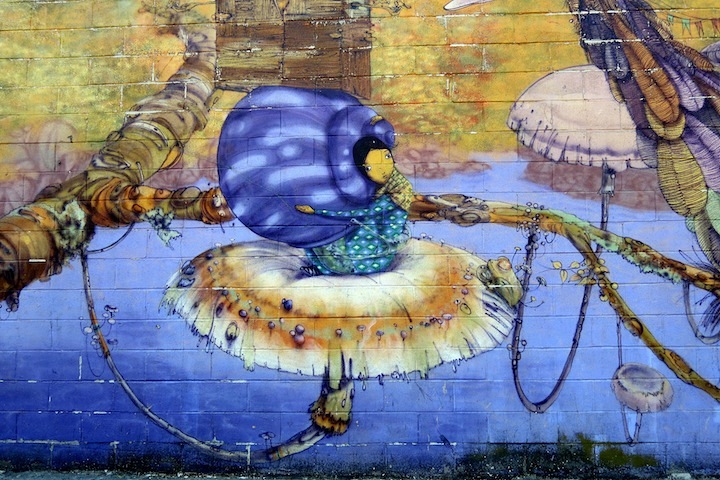
Os Gemeos in Coney Island — since 2005

os-gemeos-street-art-in-Coney-Island-NYC

Noh J Coley at the Woodward Gallery Project Space on the Lower East Side

Nohjcoley-street-art-in-NYC

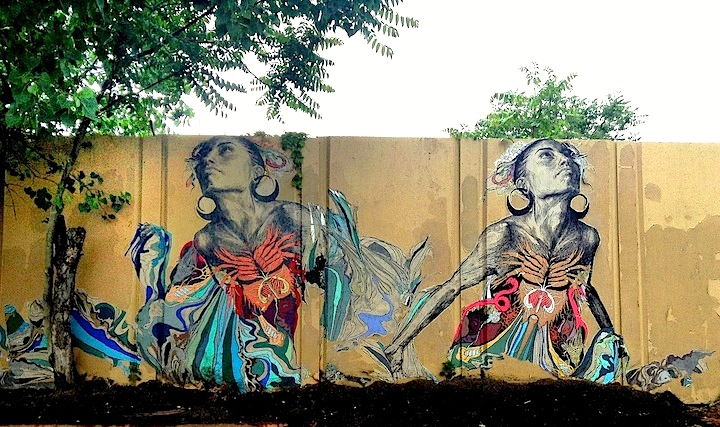
 Swoon in Clinton Hill, Brooklyn garden

swoon-street-art-in-Brooklyn-NYC

Photos by Tara Murray and Lois Stavsky

{ 0 comments }

While not conducting his post-doctoral research on Brain and Behavior at The Rockefeller University, Jerusalem native Yoav Litvin can be found on our city streets pursuing his passion for street art. We recently met up for a chat.

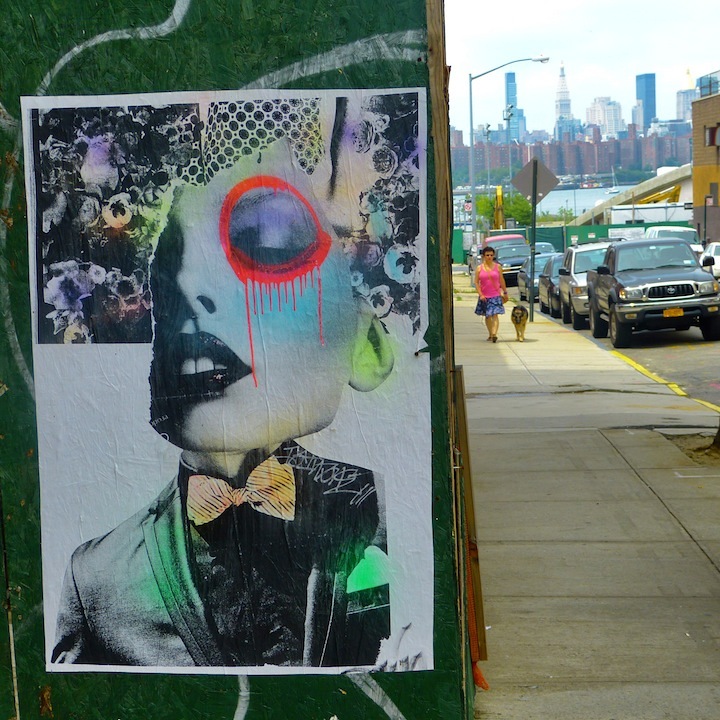
Dain

What spurred your interest in public art?

As a result of an injury, there wasn’t much I could do other than walk around.  So that’s what I did. And once I began to notice street art, I couldn’t stop taking photos of it. I also appreciate the risks artists take when putting up pieces; it’s a rush I can relate to. And I admire the artists’ generosity in taking these risks to share their vision with the public.

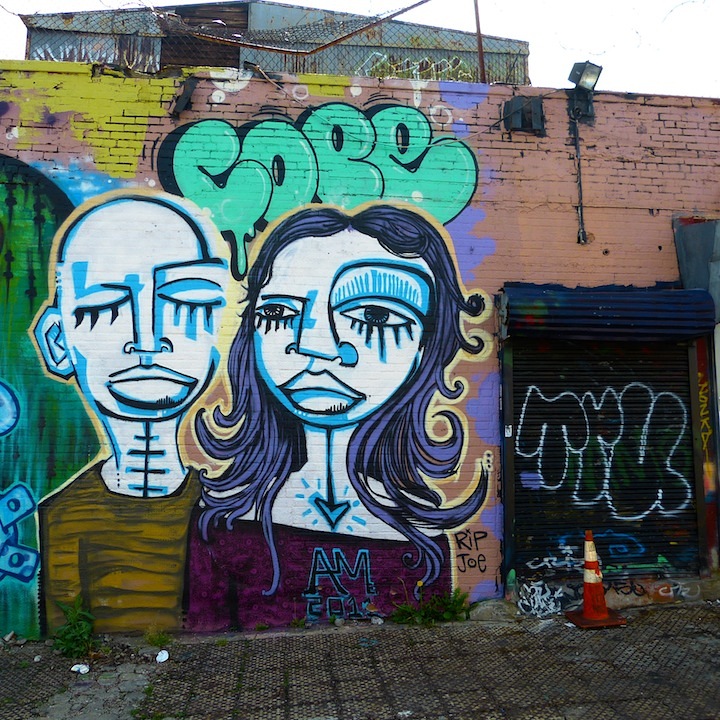
Alice Mizrachi and Cope2

What is it about street art that continues to so engage you?

I love its beauty and humor. I appreciate its aesthetic and the way it challenges convention. It is a beautiful, non-violent way to raise issues in the public sphere.  And as a political person, I am drawn to the confrontational nature of much of it.

Never Satisfied

What do you see as the role of the photographer in today’s street art movement?

Because of the transient nature of public art, I see it as essential. The image is important, but so is its context and appropriate accreditation to the artist.  And documentation of NYC’s street art trends is especially essential as this city is the world’s cultural Mecca.

gilf!

Tell us a bit about your current project.

I’ve been working for over a year now on a book that profiles 46 of the most prolific urban artists working in NYC.  It will feature images and interviews, along with some exciting supplements.

Jilly Ballistic

Have you any favorite artists whose works you’ve seen here in NYC?

There are too many to list. I love them all for different reasons.

Enzo and Nio

How do you keep up with the current scene?

In addition to documenting what I see and speaking to artists, I follow popular street art blogs such as StreetArtNYC, Brooklyn Street Art and Vandalog.  I also check Instagram daily for new images that surface not only on NYC streets, but across the globe. And I try to attend gallery openings as often as possible.

NDA and Elle Deadsex

We certainly look forward to reading your book.  Tell us more about its current progress. How close it is to publication?

I’ve finally completed the stage of collecting texts and images, and am currently working together with a first-rate designer. I am now seeking a publisher.

Yoav can be contacted at yoavlitvin@gmail.com

Featured photos are in the following sequence:

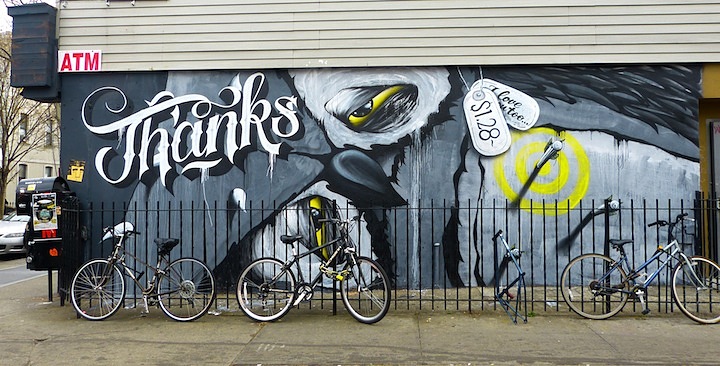
1) Dain. Wythe Avenue, Williamsburg, Brooklyn.

2) Alice Mizrachi and Cope2. Boone Avenue, The Bronx.

3) Never Satisfied. Bedford Avenue, Williamsburg, Brooklyn.

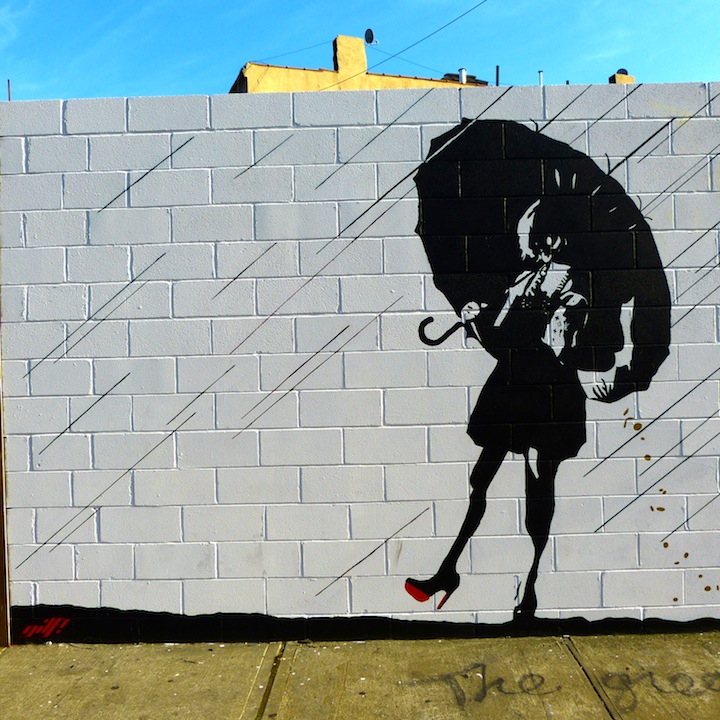
4) gilf! Grattan Street, Bushwick, Brooklyn.

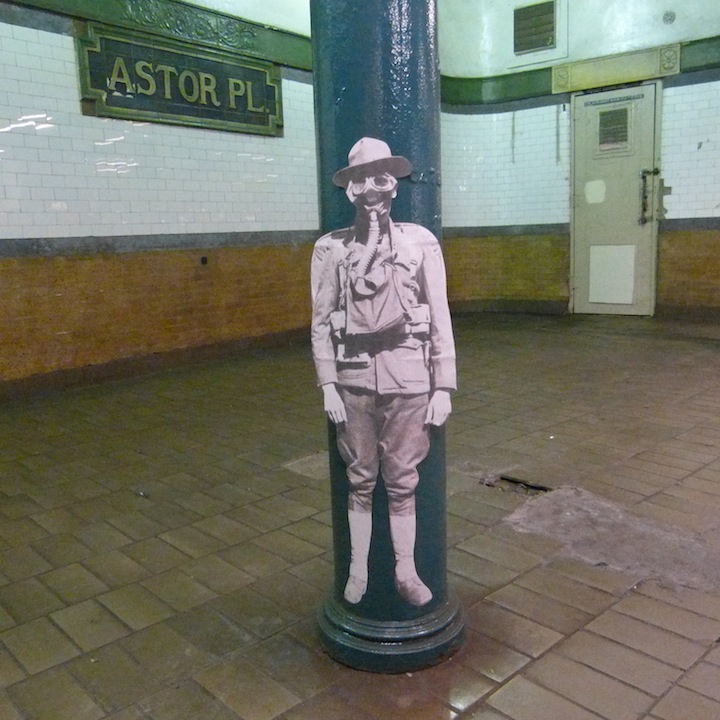
5) Jilly Ballistic. Astor Place 6 Train station, Manhattan.

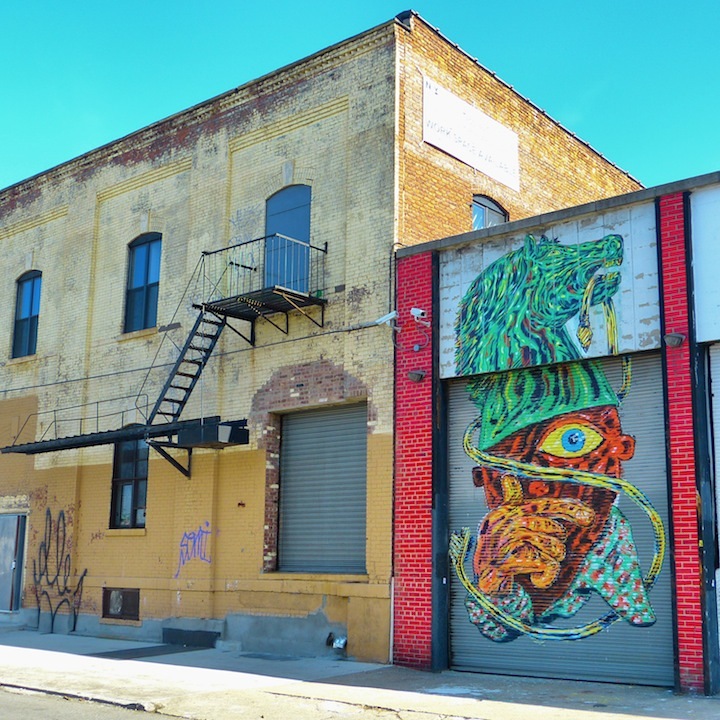
6) Enzo and Nio. Wythe Avenue, Williamsburg, Brooklyn.

7) ND’A and Elle Deadsex. Jefferson Street, Bushwick, Brooklyn.

All photos by Yoav Litvin.

{ 2 comments }

Speaking with Semor

May 20, 2013

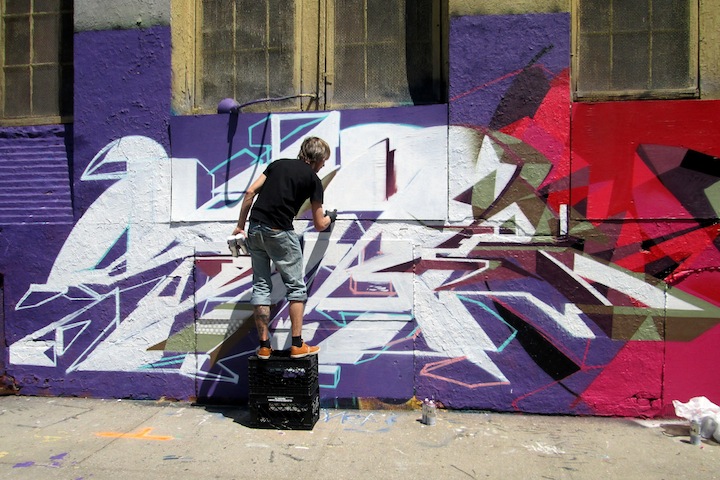
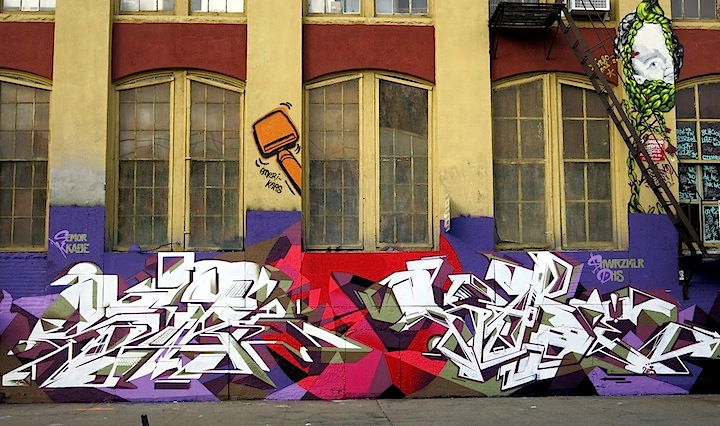
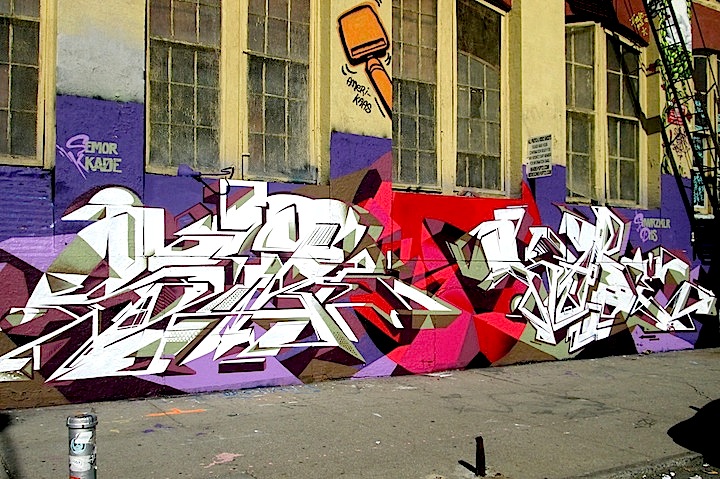
Germany’s masterful graffiti artist Semor returned to 5Pointz earlier this month, where he once again graced its walls with his outstanding skills. This time we has the opportunity to speak to him.

When did you first get up? And where was it?

I was 11 years old when I first hit a wall. It was in an abandoned area in the middle of nowhere. I grew up in a village near Cologne, Germany where there was no graffiti — or just about anything — on the walls.

Then — how did you get into graffiti?

As a young child, I destroyed my room with chalk. This started when I was about six. I always focused on letters. One day my sister said to me, “What you are doing is graffiti.”  And she bought me a copy of Style Wars. That was it!

And you have been doing it ever since!  What is it about graffiti that appeals to you?

I can put my all into it. I can express everything that is going on inside me and around me. I never sketch beforehand. Everything I do is freestyle. It’s what I feel at the moment. It doesn’t matter if it is a good day or bad day. I have graffiti.

Semor

How do your folks feel about what you do?

My mom loves it! And my dad admires what I’m doing, too. He is an architect.

Tell us something about your name. How did you get the name Semor?

I was always a big Simpsons’ fan and I particularly liked the character Seymour Skinner, the head of Bart Simpson’s elementary School. I just changed the spelling!

Have you any favorite surfaces?

I’ll paint on anything that is paintable, but I love big walls.

Semor

Have you ever been arrested?

Sure, but Germany actually provides us with graffiti lawyers. And you need to be caught in action in order for the police to arrest you.

Have you exhibited in galleries?  And how do you feel about the move of graffiti into galleries?

Yes! It’s been a good experience. It’s good money. And it’s time for graffiti to be given the respect it deserves.

How do you feel about the divide between street art and graffiti?

Graffiti is graffiti and street art is street art. Street artists are more concerned with getting a message out to the public.  And it often has political and social overtones. Graffiti is about style.

Semor and KKade

Any thoughts about today’s young writers?

They need to learn the importance of respect. They think getting up is cool, but too many young writers out there don’t have any knowledge of graffiti’s roots.

Any differences between the graffiti here in NYC and back home in Cologne?

There’s definitely a greater variety of styles back home. Writers there are more eager to experiment.

Have you any favorite writers?

The Schwarzmaler Crew, Sen2, Storm, Aroe MSK – among others.

Semor

How did you make contact with 5Pointz?

In 2005, I reached out to Meres via e-mail, and we’ve stayed in touch since.

Photos of Semor with Jimmy C and Semor & KKade by Lois Stavsky; Semor at work by Lenny Collado and Tara Murray

{ 2 comments }

The French NYC-based artist GOREY and Paris’s prolific PAL Crew, consisting of HORFE, CONY, TOMEK, SAEYO, MOSA, ESSO and SKUB, have brought their expressive aesthetic to the streets of the Lower East Side and to Klughaus’s pop-up location at 154 Stanton Street. A closing reception for the exhibit PALINGENESIS — that showcases the artists’ rebirth as evolving fine artists — will be held this Sunday, May 19 from 2-6pm.

On the streets — at Suffolk and Stanton

Gorey and Pal

Close-up from huge mural on Attorney and Delancey

Gorey and Pal

Gorey in the gallery

Gorey

Photos from the streets by Lois Stavsky; image of Gorey in the gallery courtesy of Klughaus

{ 0 comments }

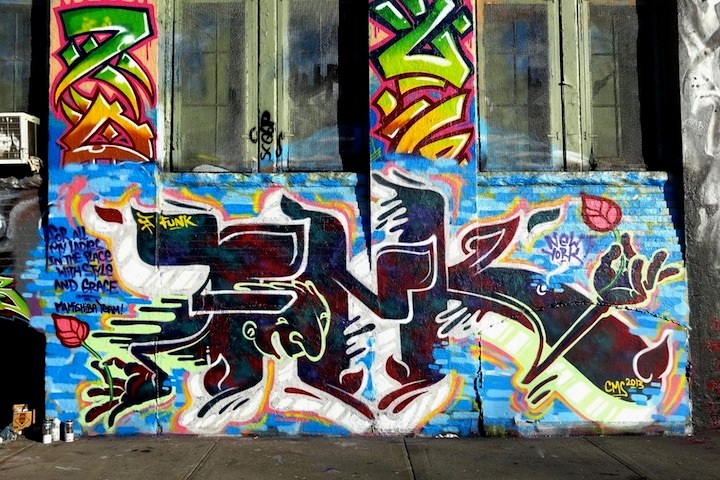
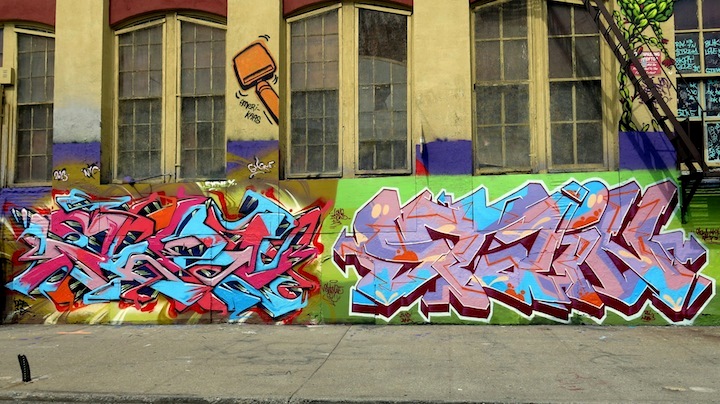
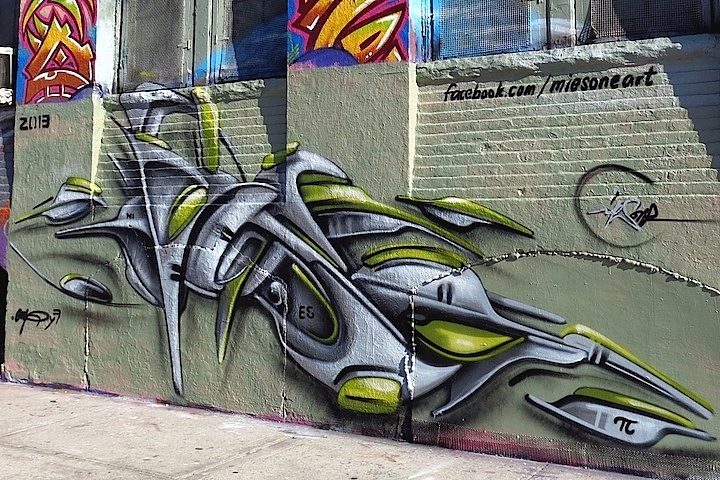
Since 5Pointz began its 11th season earlier this month, its walls have served as a canvas for artists visiting NYC from across the globe. Here’s a sampling of what has surfaced in the past two weeks:

Onur, Wes21, Kkade from Switzerland and Semor from Germany

Onur, Semor, Wes21 & KKade

Semor and KKade

Semor and KKade

Vova Zomb from Moscow

Vova Zomb

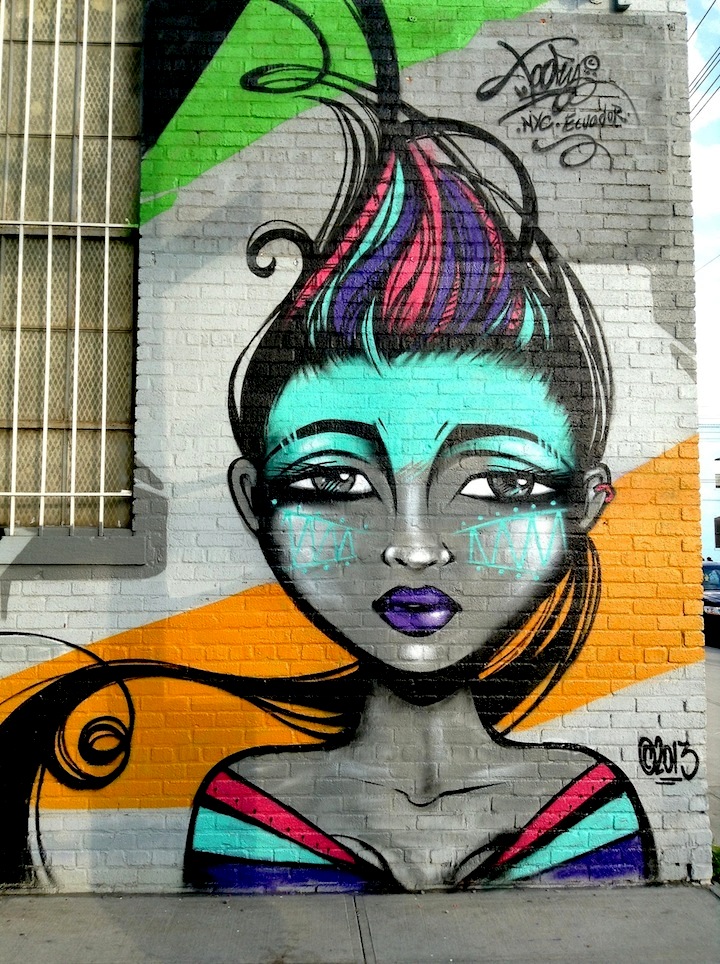
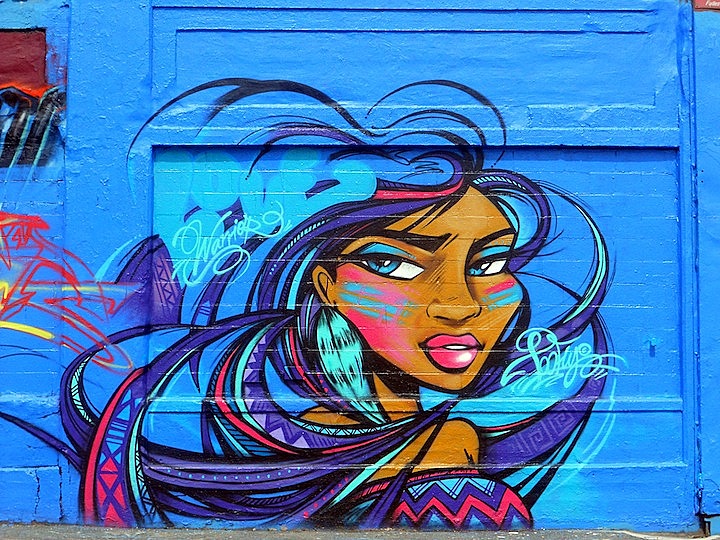
Ecuadorian artist Toofly

Toofly

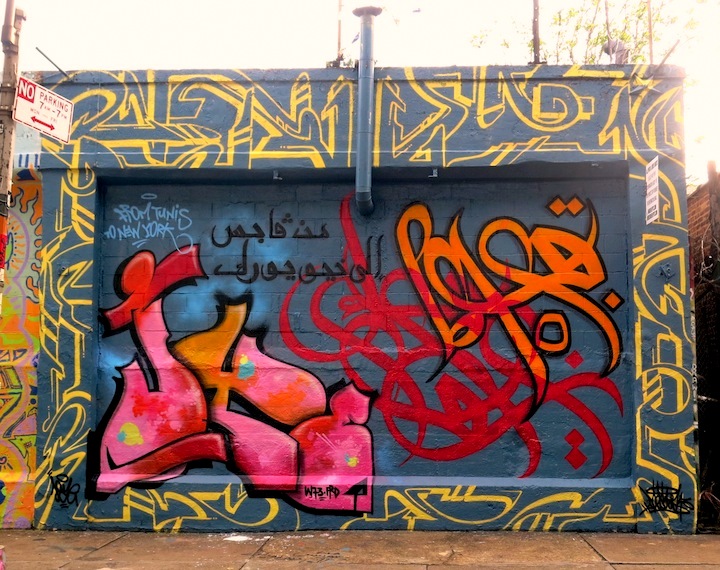
French Tunisian artist eL Seed, Jaye from Paris and Meres

eL Seed and Jaye

Funk from Montreal

Funk

Australian artists Zert and Stain

Zert and Stain

Indonesian artist MiesOne

MiesOne

Article from Houston, Texas

Article


Photos by Lenny Collado, Dani Mozeson, Tara Murray & Lois Stavsky

{ 0 comments }

Speaking with Saber

May 2, 2013

Saber

Back in 1997, Saber achieved legendary status as a writer when he completed the largest graffiti piece ever created.  On the bank of the Los Angeles River, it was almost the size of a professional football field. Since, he has achieved great acclaim for the works that he has also created indoors – his mesmeric paintings that fuse his extraordinary calligraffiti techniques with his fine art painting skills. While visiting his current exhibit at Opera Gallery the day after it opened, we had the opportunity to speak to Saber.

When did you first get up in a public space?

I was around ten years old when I tagged a bench in Glendale, my home town. I got scared and I wiped it off. I did this about ten times.

What inspired you at the time?

The first time I saw Belmont tunnel, I was blown away by its complex wild styles.

Saber art

What about shows? When did you first exhibit your work?

Back in the late 90’s in a terrible t-shirt store.

You’ve sure have come a long way. How did you hook up with Opera Gallery?

Through Ron English. We’ve been good friends for about ten years.

Saber

Do you have a formal art education?

I tried art school briefly and soon realized what a waste of time, money and energy it was. It’s a scam. I got a crash course in art doing graffiti. Graffiti informed me. And my parents are artists. I was always painting.

Any thoughts about the graffiti/ street art divide?

I love it all. Street art is more accessible and graffiti is about style and getting up. Your signature is the essence of your life, as it lives on long after you do. Wild style is the true heart of street art. “Street art” is just a general term.

What is the riskiest thing you ever did?

Having a child. She’s two years old.

Saber

What do you see as the future of street art and graffiti?

Street art is going far more mainstream. Graffiti goes in cycles; that’s what makes it graffiti.

What do you see as the role of artist?

To reflect back on society.

The exhibit continues until May 11 at 115 Spring Street in SoHo.

Photos by Lois Stavsky

{ 1 comment }
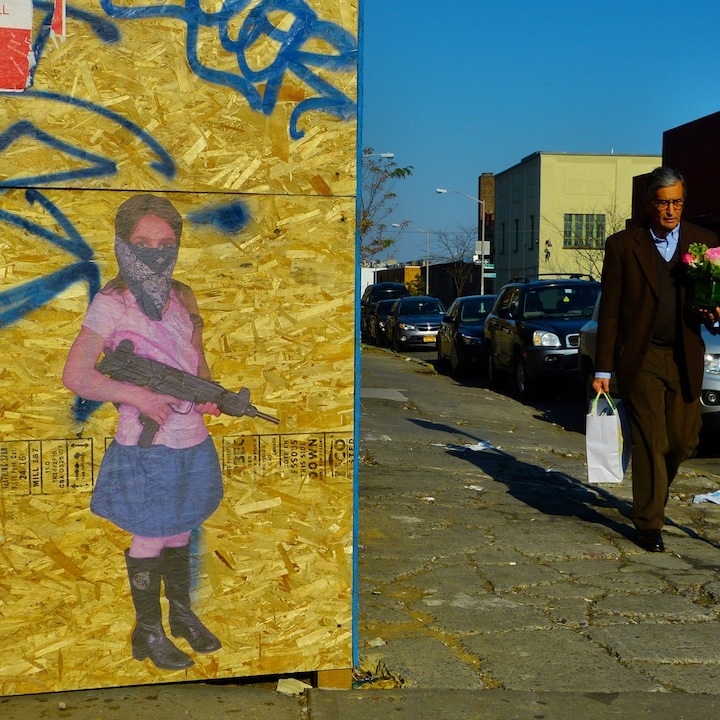
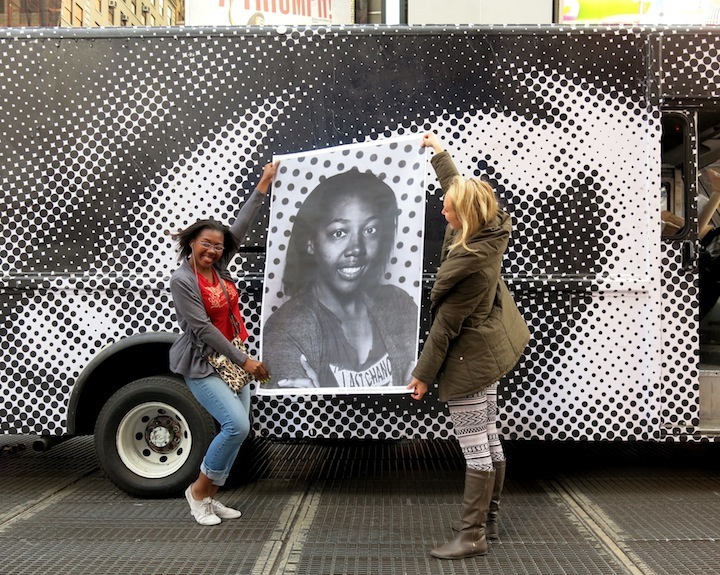
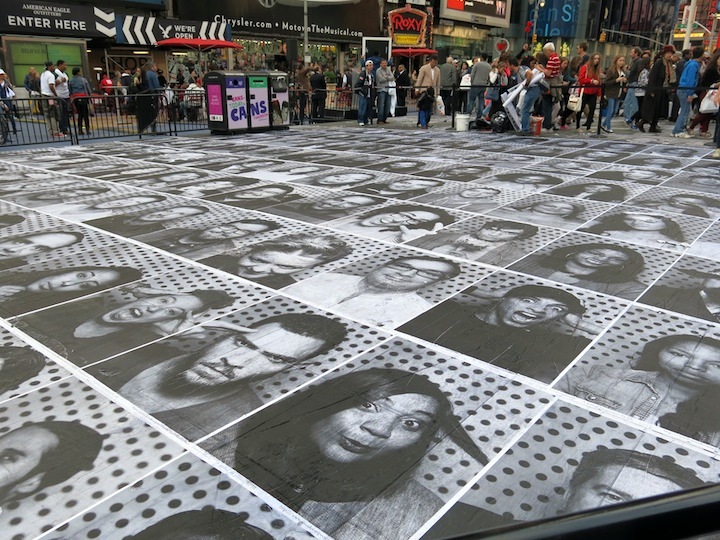
A range of faces surface daily on NYC’s public spaces — from RAE’s offbeat, endearing characters to JR’s remarkable Inside Out NYC project. Here are a few:

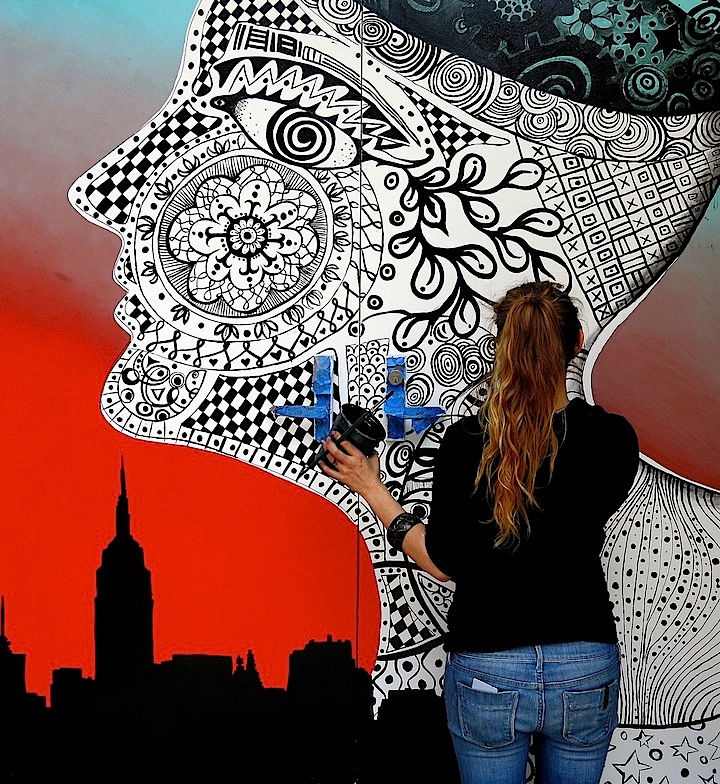
RAE in Manhattan

RAE

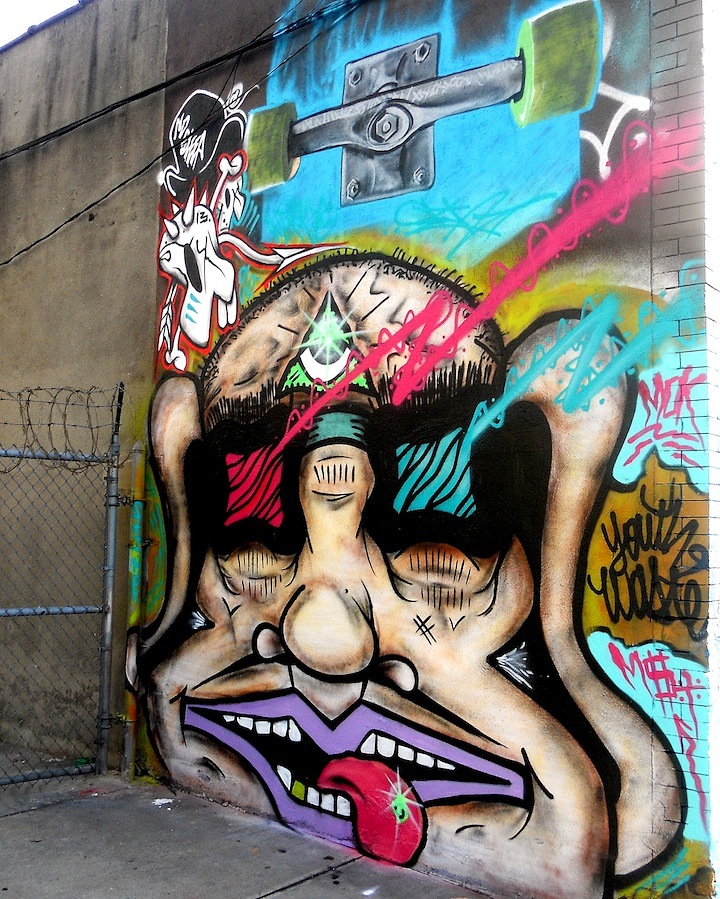
Youth Waste in Brooklyn (with Werds on top left)

Youth Waste

Veng at Welling Court in Astoria, Queens

Veng

The Yok in Brooklyn

The Yok

Ewok in Bushwick

Ewok-street-art-in-Bushwick-Brooklyn-NYC

Joseph Meloy in Manhattan

Joseph Meloy in Manhattan

Aimee Cavazzi in Manhattan

Aimee Cavazzi

JR’s Inside Out NYC Project in Times Square

JR

JR

 Photos by Dani Mozeson, Tara Murray and Lois Stavsky

{ 0 comments }
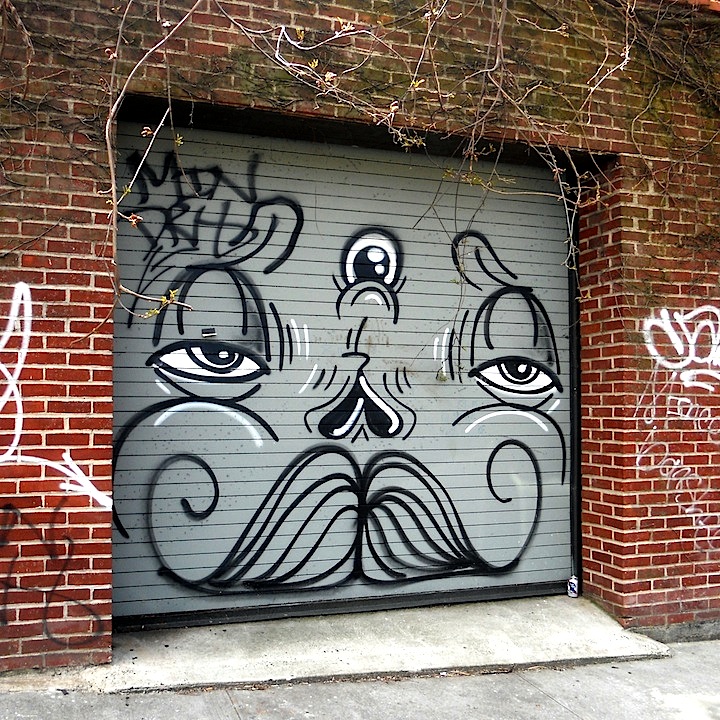
Several first-rate writers have been busy in Bushwick this past week. Here are a few images:

Versatile style master Curve

Curve

Veteran NYC writer Wane COD

Wane

NYC-based Enue COD

Enue

West Coast-based Vizie MSK

Vizie

Jick in action

Jick

Mast in action

Mast

West Coast legend Rime MSK

Rime

Keep posted to our Facebook page for many more first-rate graff pieces that have recently surfaced in Bushwick.

Photos by Lenny Collado and Lois Stavsky


{ 0 comments }
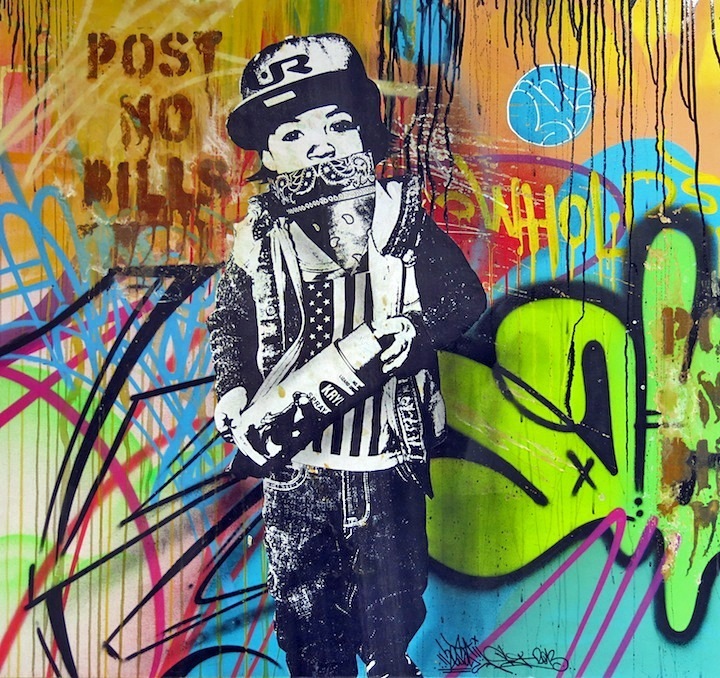
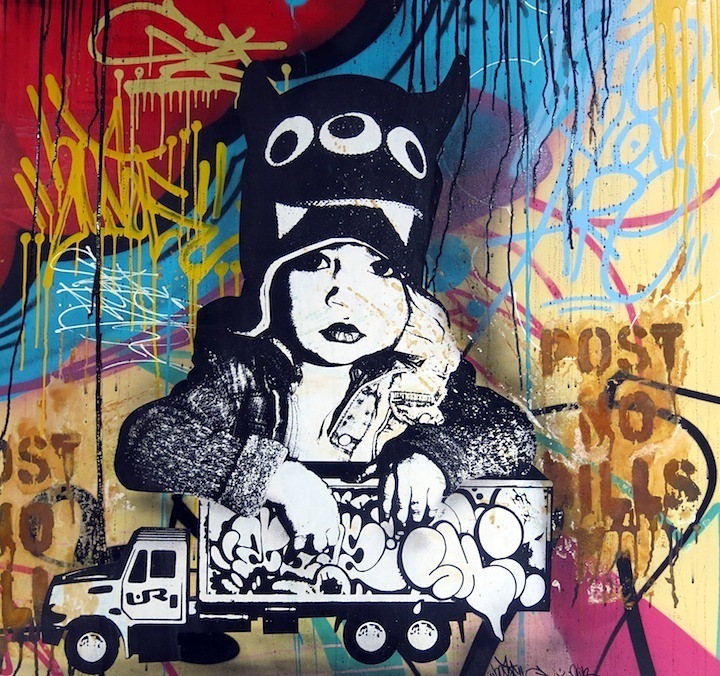
UR New York

We recently had the opportunity to speak to the dynamic Mike Baca aka 2ESAE and Fernando Romero aka SKI of the collective UR New York at Pop International’s new pop-up location at the Atrium at 153 East 53rd Street – where a vibrant new series of the talented duo’s art is on view.

When was UR New York born?

Mike: It started back in 2002 as a clothing line. But it died out for a while.

Fernando: Then in 2011 we revived it as an art collective.

You two are such a great team. How did you guys meet?

Fernando: We met through a mutual friend in 2005.

What would you say is the key to your success as a team?

Fernando: We don’t let the success get to us. We do what we do because it feels right.  As individuals we’re strong, but when we work together as a team, we are even stronger. And we are like brothers.

Do you guys have a mission of some kind?

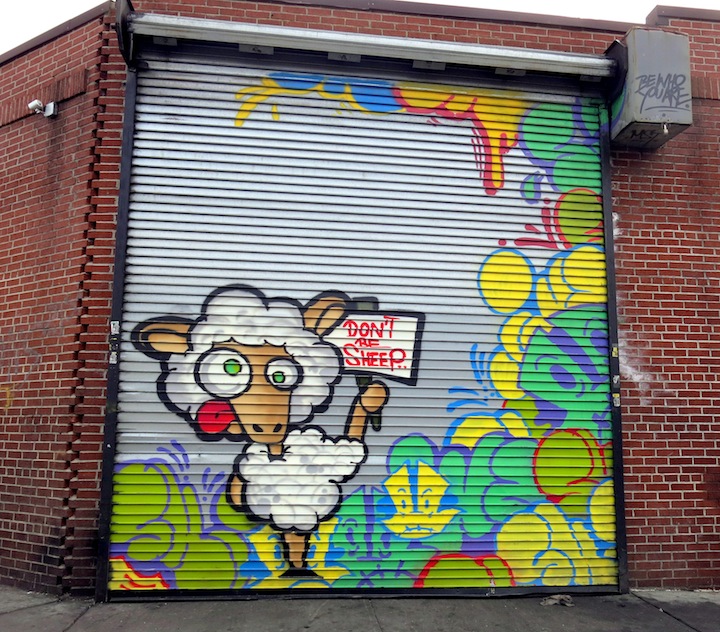
Fernando: It’s all about individuality. Most people are sheep. The message is: Don’t be sheep. Be who you are, and be the best that you can be – whoever you are and whatever you do.

UR New York street art

Have you a formal art education?

Mike: I went to the High School of Art and Design.

Fernando: I graduated from Parsons in 2006.

Any thoughts about art school, Fernando?

It was an amazing experience. I met so many talented people – students and teachers — and I now have friends from all over the world.

How has your work evolved in the past few years?

Fernando: We’ve begun to focus much more on detail. We experiment with different styles and variations of colors.

Mike: We’ve learned how to step out of our comfort zone.

UR New York

How do you feel about the movement of graffiti into galleries?

Fernando: Even though it’s been going on for awhile, it’s a process. It will take awhile for graffiti to be accepted by the art establishment.

Mike:  As long as you keep it real, it’s a great platform. And at this gallery – Pop International – a percentage of our sales goes to CAW, a non-profit that offers free arts workshops to kids uptown.

Tell us something about your experiences here at Pop International and CAW.

Mike: It’s been awesome. The folks here at Pop International are like family to us. And through CAW, we’ve been working with kids. It’s great serving as role models.

Fernando:  Definitely. It’s been a great experience. And we get to hang out in this gallery and see our artwork hanging alongside the likes of Keith Haring and Basquiat!

Who are some of your favorite artists?

Fernando: Among my favorites are: KA, Belin from Spain and my partner, Mike Baca!

Mike: I like Skewville, REVS, Smart CrewKA and See One.

UR New York and KA

Any thoughts about the graffiti/street art divide?

Mike: I can appreciate street art. I like the way it interacts with the environment. But there’s a natural tension between graffiti writers and street artists, as many writers risked their lives to make their mark. But we’re all in this together, playing in the same arena.

Have you any first graffiti memory that comes to mind?

Mike:  I remember finding a can of spray paint in my basement. I took it to school with me and wrote my name in the schoolyard. I got suspended.

Fernando: I was about six years old when I saw my cousin writing for the first time in Astoria, Queens. By the time I was ten, I started writing my name around my neighborhood.

What percentage of your time is devoted to art?

Mike: My whole life is devoted to art. I don’t have a day job, and I almost never sleep.

Fernando: When I’m not making art, I’m thinking about what I’m going to make.

UR New York

Any artists out there you’d like to collaborate with?

Fernando: How and Nosm, Os Gemeos, C215, Jose Parla, Doze Green, WK Interact

Mike: If I could collaborate with anyone, I’d choose BluRoa and Mode.

Any thoughts about the role of the Internet in all this?

Fernando: I see it as good and bad. It’s good because it can give an artist mass exposure. But – at the same time – a nobody can become a somebody. And that’s not good.

Mike: The Internet is the devil. There’s just too much information out there.  But on the plus side, you can get to show your work anywhere.

Any theories as to why graffiti is more embraced in Europe than here in the US?

Mike: People are more relaxed there and more appreciative of everything.

Fernando: Europeans are generally more open than Americans. They’re more laid back. Art has been a part of  European culture far longer, and Europeans tend to respect and appreciate it more.

KA and UR NewYork

Which countries have you guys painted in?

Fernando: Australia, Italy, Austria, Israel, Brazil, the Dominican Republic, Canada, much of the US and Puerto Rico.

Any favorite cities?

Fernando: There’s nothing like NYC.

Where do you get your inspiration?

Fernando: Women, cars, buildings…just walking with my eyes open inspires me.

Mike: NYC. It’s a monster. It’s always alive and a constant source of inspiration.

Tell us something about your process.

Mike: It’s organic. We just let it flow.

Are you generally satisfied with your work?

Mike: We always strive to make it better.

What’s ahead?

Mike: Painting on a larger scale; working more with children and curating shows for people who don’t have the opportunities that we have.

Fernando: All that and making five times as much money!

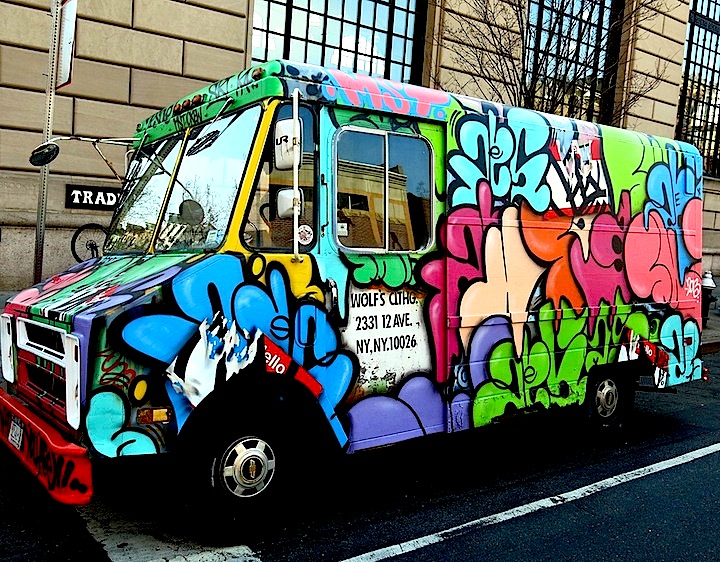
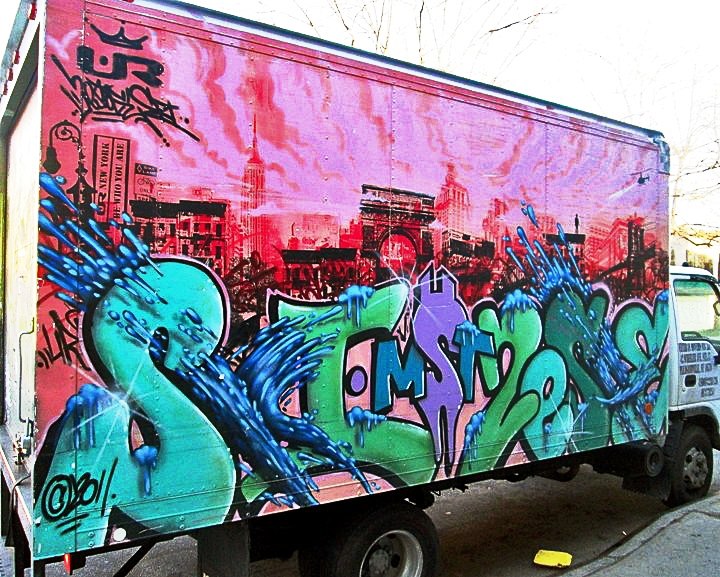
Photos by Dani Mozeson and Lois Stavsky; the two trucks featured are by UR New York in collaboration with KA

{ 1 comment }